MVP Development Cost in 2026: What to Budget and What to Cut
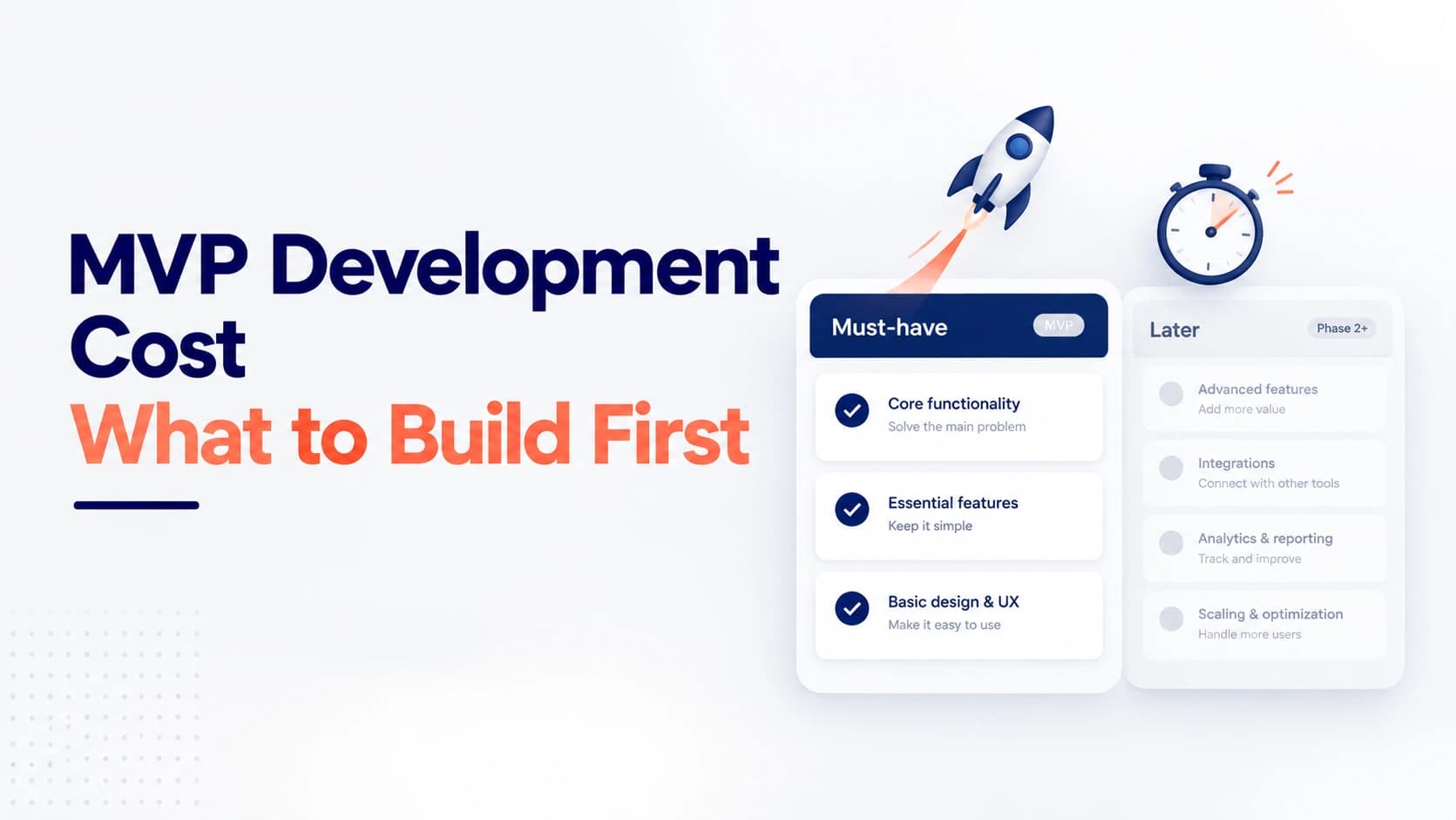
The biggest factor in MVP development cost isn't the agency you pick or the tech stack. It's building version two first. A founder writes down everything the product will one day do, calls that list the MVP, and pays for months of work before a single customer has logged in.
The short answer: SaaS MVP development cost with us starts from $4,499 and usually takes about 5 to 8 weeks. That buys a real, working product: sign-in, one core feature done properly, simple billing and a basic admin view. How far above that figure your first version lands depends almost entirely on scope, not on anyone's hourly rate.
These are general timelines and prices for typical projects, not a quote. For an exact timeline, quote and pricing, book a free consultation.
The rest of this post is about that scope: what pushes the price up, which features can safely wait, and what you'll pay once the product is live. If speed worries you more than budget, our post on launching a SaaS MVP fast without overbuilding it covers the mindset. This one is about money.
How Much Does It Cost to Build a SaaS MVP?
Our SaaS product builds start from $4,499. For that, people can sign up and sign in, do the one thing your product exists for, and pay you for it, and you get an admin view showing who's using it. Run our planner with nothing added and that base comes to about $4,500 and 5 weeks.
What it doesn't include is the rest of your wish list. That's deliberate.
Two other routes are worth knowing about. If your first version really is a phone app, our mobile app builds start from $3,499. If it's not a subscription product at all, say a customer portal or an internal tool, it's a custom web app, which we quote after a short scoping call because one starting number wouldn't be honest.
Guides online quote MVP ranges running from five figures into six. They're not wrong, exactly. They're answering a question about scope while pretending it's about price.
What Drives MVP Development Cost
Every feature costs design, build and testing time. A few cost far more than founders expect, because they touch everything else.
User roles. One type of user means one set of screens. Add owners, managers, staff and clients, and every screen has to know who's looking and what they may do. In our planner, teams, roles and permissions add about a week and a half on their own.
Integrations. Connecting to a CRM, an accounting package or a calendar sounds like plumbing. In practice every outside system has its own rules, limits and bad days, and your product has to cope when it's down. The planner counts about a week and a half for integrations.
Payments. Charging your customers a monthly subscription is part of the base. Moving money between users, where buyers pay sellers and you take a cut, is a different job entirely: seller onboarding, payouts, refunds, disputes. That's about two weeks in the planner, and it's one of the first things we'd ask you to question.
Admin tools. A basic admin view is included. A full back office with bulk editing, detailed reports and "log in as this customer" is closer to a second product.
AI features. About two and a half weeks in the planner, plus a running cost every time someone uses them. If AI is the reason your product exists, it isn't an add-on; it's your core feature, and the MVP should be built around it. If it's there because every pitch deck has it this year, it can wait.
Platforms. A native mobile app next to the web app is the single biggest jump in the planner: about four weeks on its own. A responsive web app works on phones for most early users, so we'd usually start there and build the app once people come back often enough to want it on their home screen.
A Worked Example: Four Features Later, Six Weeks Sooner
This one is hypothetical, but it's a very typical shape. Say you're building a scheduling tool for independent dog groomers. The base covers sign-in, the core booking feature, billing and the admin view. On top of that, your list has six more things.
Must-haves: guided onboarding (so a groomer can set up without calling you) and email notifications (so clients know their booking went through).
Later: teams and roles for salons with several groomers, integrations such as calendar sync, an analytics dashboard, and AI features like smart rebooking reminders.
Put that split into our MVP development cost calculator (its default settings are exactly this example) and it shows the focused MVP at about $5,200 and 6 weeks. Building everything at once comes to about $8,200 and 12 weeks.
That's $3,000 and six weeks spent before a single groomer has taken a booking through your product. Launch the 6-week version and those groomers will tell you which later features they actually miss. Often one or two never matter, and the money goes into something people asked for.
Two more numbers from the planner. Move the mobile app into the must-haves and the focused MVP becomes about $7,900 and 10 weeks. Tick every feature the planner offers and you're looking at about $14,000 and 21 weeks, which is the "version two first" mistake expressed as a single figure.
How to Reduce MVP Development Costs: What to Cut, and What Never to Cut
The cheapest way to reduce MVP development cost is to build less, not to pay less per hour.
Here's the test we use on every must-have: if this were missing in the first month, would a paying user leave? If the answer is no, it goes on the later list.
A few things never get cut, though, because without them you can't learn anything from the launch:
Sign-in that works properly, including password reset. Someone will forget their password on day two.
The core workflow, end to end. One job, done completely, beats five jobs done halfway.
Billing, if you plan to charge. We'd charge from day one, even a small amount. Free users tell you whether something is interesting; paying users tell you whether it's useful.
Basic analytics. Not a dashboard for customers, just enough tracking for you to see who signed up, who came back and whether they used the main feature.
Backups and error monitoring. Cheap to set up, and very expensive to discover you skipped.
And the things that can almost always wait: customer-facing dashboards, teams and permissions, integrations (an export to a spreadsheet covers a surprising number of early requests), multiple languages, a public API, a native app, and AI that's there to look impressive rather than to do the core job.
MVP vs Prototype vs Full Product
These three get mixed up constantly, and the mix-up is expensive.
Prototype: clickable designs that show how the product would work. Nobody signs up and nothing is stored. It proves people understand the idea. Cheap, fast and useful for early interest.
MVP: a real, working first version that people sign up for and ideally pay for. It proves the business works, or shows you quickly that it doesn't. This is what the $4,499 starting price covers.
Full product: the MVP plus what real users asked for: teams, integrations, reporting, maybe a mobile app. You build this from evidence, not from the original wish list.
An honest note: we don't think every idea needs a custom MVP straight away. If you haven't yet talked to a dozen people who'd use the product, do that first. If you can test demand with a no-code tool, or by doing the work by hand behind a simple sign-up form, that's a perfectly good first step, and we'll happily tell you so on a call. If you're still choosing what to build, our list of SaaS ideas you can launch this year is a good place to start testing.
The Costs That Show Up After Launch
The build is the biggest cheque, not the last one.
Hosting and services. Early MVP hosting is usually modest and grows with usage. Add email sending, a domain, storage and any paid APIs: small on their own, a real monthly line together.
Payment fees. Stripe's standard pricing for domestic cards in the US is 2.9% plus 30 cents per successful charge. On a $5 plan that's about 45 cents, close to 9% of the price, so put it in your pricing model early.
App store accounts, if you go mobile: the Apple Developer Program is $99 a year, and a Google Play developer account is a one-time $25.
AI usage. If the product calls an AI model, you pay per request. Usually small per user, occasionally surprising in total, so we build in limits from the start.
Support and maintenance. Someone has to answer users, apply security updates and fix the odd bug. Our maintenance plans start from $97 a month.
The first round of changes. This is the one founders forget. Your first users will ask for things, and some of those requests will be the most valuable work you ever pay for. We'd hold back a meaningful slice of your total budget for it; a quarter is a sensible starting point.
How to Scope Your MVP Properly
Start by writing one sentence: who the product is for, and the single job it does for them. If you can't get it into one sentence, the scope isn't ready yet, and no developer can price it accurately.
Then turn that sentence into a brief. Our free AI project brief generator takes three or four sentences about your idea and returns a structured brief: usually 6 to 12 features each marked must-have or later, a suggested stack, phases, risks and the questions to settle before building. The budget and timeline in it come from the same pricing model as our cost calculator, not from the AI guessing.
Run its must-have list through the "would a user leave?" test and check the effect in the MVP planner. If you're not technical, our SaaS development checklist for non-technical founders covers the questions to ask any developer, including us.
Last, book a scoping call. We'll pressure-test the list, tell you what we'd cut, and turn it into a fixed price and timeline.
Frequently Asked Questions
How much does it cost to build an MVP? With us, a focused SaaS MVP with sign-in, one core feature, billing and a basic admin view starts from $4,499. A typical first version with onboarding and email notifications comes to about $5,200 in our MVP planner, and each extra feature adds to that.
How long does it take to build an MVP? A focused SaaS MVP usually takes about 5 to 8 weeks. Our planner puts the bare base at about 5 weeks and the common onboarding-plus-notifications version at about 6. A native mobile app alongside it adds roughly four weeks.
Should I build an MVP with no-code tools first? If you're still testing whether anyone wants the product, often yes. No-code is fast and cheap for proving demand. Once real users depend on it, you tend to hit limits on custom logic, speed and data ownership, and that's usually the point to build properly.
What features should an MVP include? Only what a user needs to get the core value once: sign-in, the main workflow from start to finish, billing if you're charging, and enough analytics to see who comes back. Teams, integrations, dashboards and most AI features can follow.
What's the difference between an MVP and a prototype? A prototype shows how the product would work, usually as clickable designs, and nobody signs up to it. An MVP is a working product that people sign up for and pay for. The prototype tests the idea; the MVP tests the business.
How can I reduce MVP development costs? Build less, not cheaper. Move every feature that fails the "would a paying user leave without it?" test to the later list, launch as a responsive web app before adding a native mobile app, and test demand with a prototype or a manual process first if you haven't spoken to real users yet. In our MVP planner, keeping four features for later takes the example product from about $8,200 and 12 weeks to about $5,200 and 6 weeks. Then hold back about a quarter of your budget for the changes your first users ask for.
Keep reading
How to Create an MVP for a SaaS Startup (Fast, Without Overbuilding)
SaaS Development Checklist for Non-Technical Founders (2026)
Ready to Price Your First Version?
Scoping lean first versions is a big part of what we do through our SaaS product development and custom web app development services. Our experienced team will tell you what to build now, what to leave for later, and what it costs, in writing, before any work starts.
Send us your idea, and we'll reply with a clear scope, timeline and fixed quote within 6 to 12 hours.