
SaaS Development Checklist for Non-Technical Founders
SaaS Development Checklist for Non-Technical Founders
There's a specific kind of stress that hits non-technical founders somewhere around the second or third conversation with a developer. Terms start piling up: backend, API, database schema, hosting, authentication provider, and it starts to feel like you need a computer science degree just to have an informed opinion about your own product.
You don't. Plenty of successful SaaS founders have never written a line of code, and that's genuinely fine. What actually matters isn't technical fluency. It's knowing what to prepare before you talk to a developer, what questions separate a good technical partner from a risky one, and where non-technical founders most commonly get stuck so you can sidestep those traps entirely.
This is the checklist we'd hand a first-time, non-technical founder before their first serious conversation about building a SaaS product.
Before You Talk to a Single Developer
Validate that the problem is real
This has nothing to do with code, and it's the step most likely to get skipped because it feels less productive than building something. Talk to at least a handful of people who'd actually be your target customers. Ask what they're doing today to solve this problem, not just whether they think your idea sounds good — people are polite, and "that sounds cool" means almost nothing. What you're actually listening for is whether they're already spending time or money working around this problem, because that's the real signal that a paying product could exist here.
Get specific about who you're building this for
"Small businesses" or "teams" isn't specific enough to build a product around. The more precisely you can describe your ideal customer, their industry, their team size, the tool they're currently using instead of yours, the moment they'd realize they need something better, the easier every later decision becomes, including the technical ones. A developer building for "freelance bookkeepers managing five to fifteen clients" can make far better technical trade-offs than one building for "small businesses" in the abstract.
Write down the one thing your product absolutely must do
Before any conversation about tech stacks or architecture, be able to finish this sentence clearly: if a user could only do one thing in this product, it would be. Everything else is secondary until that core action works well. This single sentence will save you from a huge amount of scope creep later, and it's something only you can define; no developer can hand you clarity you haven't figured out yourself.
Sketch the core user flow, even badly
You don't need design skills. A rough sequence of screens on paper or in a simple tool sign up, land here, do this one thing, see this result gives a developer something concrete to react to, instead of trying to build your product from a paragraph description. This step alone tends to surface half the ambiguities in an idea before a single line of code gets written.
Understanding Enough to Not Get Taken Advantage Of
You genuinely don't need to become technical, but a handful of concepts are worth understanding at a surface level because they directly affect cost, timeline, and how much control you'll have over your own product later.
Know roughly what "MVP" should mean for your product
An MVP isn't a stripped-down version of your full vision; it's the smallest thing that proves people will actually use, and ideally pay for, your solution. If a proposed MVP already includes ten features, team permissions, and an admin analytics dashboard, that's not an MVP. That's a much bigger, slower, more expensive first version than you actually need, and it's worth pushing back on.
Understand the basic shape of a modern SaaS stack
You don't need to choose the specific technologies, but knowing the rough categories helps you follow a technical conversation instead of nodding along blindly. Most modern SaaS products involve a frontend (what users see), a backend (where data and business logic live), a database (where information is stored), authentication (how users log in securely), and payments (how you actually charge people). When a developer explains their proposed approach, you should be able to at least map it onto these categories, even if you don't know the specific tools involved.
Ask who owns the code and the accounts
This one gets skipped constantly and causes real problems later. Make sure you, not the developer or agency, own the actual codebase, the domain, the hosting account, and any third-party service accounts (payments, email, analytics) tied to your product. If a relationship with a developer ends badly, you want to be the one holding the keys, not negotiating to get them back.
Understand the difference between a fixed quote and an ongoing partnership
Some development work is a one-time build with a fixed scope and price. Other arrangements are ongoing, iterative partnerships priced by time or retainer. Neither is inherently better, but you should know clearly which one you're agreeing to, because the two create very different expectations about what happens when you inevitably want to change or add something after the initial build.
Questions Worth Asking Before You Hire Anyone
Can you show me something similar you've built before, ideally something I can actually use or click through?
What would you consider out of scope for the MVP we've described, and why?
Who owns the code, accounts, and infrastructure once this is built?
What happens if I need changes after launch? Is that included or a separate cost?
How will you help me avoid overbuilding this before we know if people want it?
That last question is worth paying close attention to the answer to. A developer or agency that pushes back on scope and asks why you need a given feature before validating demand is generally a better sign than one who happily agrees to build everything you initially describe.
Mistakes Non-Technical Founders Make Most Often
Treating the first version like it needs to be the final version. The instinct to make the MVP feature-complete and polished is understandable, but it usually just delays the point where you learn whether anyone wants the product at all. Version one exists to get real feedback, not to impress anyone.
Not budgeting for anything after launch. A lot of founders plan and save for the initial build, then are caught off guard when bugs need fixing, hosting costs come due, or customers start asking for something the MVP didn't include. Ongoing costs are part of running software, not an unexpected extra.
Choosing a developer based on price alone. The cheapest quote is sometimes genuinely fine, but it's also where a lot of founders end up with code nobody else wants to touch later, forcing an expensive rebuild down the line. Price matters, but so does whether you can actually see and evaluate the developer's previous work.
Being vague about requirements and expecting the developer to fill in the gaps. Developers can build what you describe, but they can't read your mind about details you haven't actually decided yet. Time spent clarifying your own requirements before a project starts is almost always cheaper than paying to rebuild something after a misunderstanding.
Skipping a written agreement on scope. Even a simple, plain-language document describing what's included, what's not, and what happens with changes protects both sides and prevents the classic slow scope-creep spiral that delays so many first launches.
A Simple Pre-Launch Checklist
Before committing budget to a build, it's worth being able to say yes to each of these:
I've talked to real potential customers about this problem, not just people who know and like me
I can describe my ideal customer specifically, not just broadly
I know the one core thing this product absolutely needs to do
I have a rough sketch of the main user flow
I understand roughly what should and shouldn't be in an MVP
I know who will own the code, domain, and accounts once it's built
I have a written scope agreement before development starts
I've budgeted for maintenance and changes after launch, not just the initial build
If most of these are true, you're in a genuinely strong position to start a SaaS build without a technical background getting in your way.
Frequently Asked Questions
Do I need to learn to code to build a successful SaaS product? No. Plenty of non-technical founders build successful SaaS products by focusing on the problem, the customer, and the product decisions, while partnering with a developer or agency for the technical execution. What matters is understanding enough to make informed decisions and ask the right questions, not writing the code yourself.
How do I know if a developer or agency is trustworthy? Look for previous work you can actually evaluate, clear answers about scope and ownership, and a willingness to push back on unnecessary features rather than agreeing to build everything you ask for. Vague answers about ownership or timeline are a common warning sign.
What's the biggest mistake non-technical founders make when building their first SaaS product? Overbuilding the first version before validating that anyone wants it. It's an understandable instinct, but it usually delays the most important discovery, whether the core idea actually solves a problem people will pay for.
Should I hire a freelancer, an agency, or try a no-code tool first? It depends on complexity and budget. Simple ideas can sometimes be validated with no-code tools before investing in custom development. More complex products, or ones central to a serious business, usually benefit from a developer or agency who can build a proper technical foundation from the start.
Final Thoughts
Not knowing how to code was never the real obstacle for non-technical founders. The real obstacle is walking into development without having done the thinking that only a founder can do, validating the problem, defining the customer, deciding what the product must do at its core, and understanding enough of the basics to ask good questions and protect your own ownership of what gets built.
Get that part right, and the technical side becomes something you can manage well with the right partner, not something you have to personally master.
Ready to Build Your SaaS Product?
If you've got a clear idea of the problem you're solving but need the right technical partner to bring it to life, our team works specifically with non-technical founders, helping scope a focused MVP, avoid overbuilding, and build something you'll fully own from day one.
Tell us about your idea, and we'll help you figure out exactly what the first version should include, and just as importantly, what it shouldn't.
More posts
All posts →
10 SaaS Ideas You Can Launch This Year
You don't need a groundbreaking idea to build a successful SaaS product; you need a real problem, a specific audience, and the discipline to launch before it feels perfect. Here are 10 SaaS ideas that are genuinely buildable right now, with the tools available today.
How to Launch a SaaS MVP Fast Without Overbuilding It
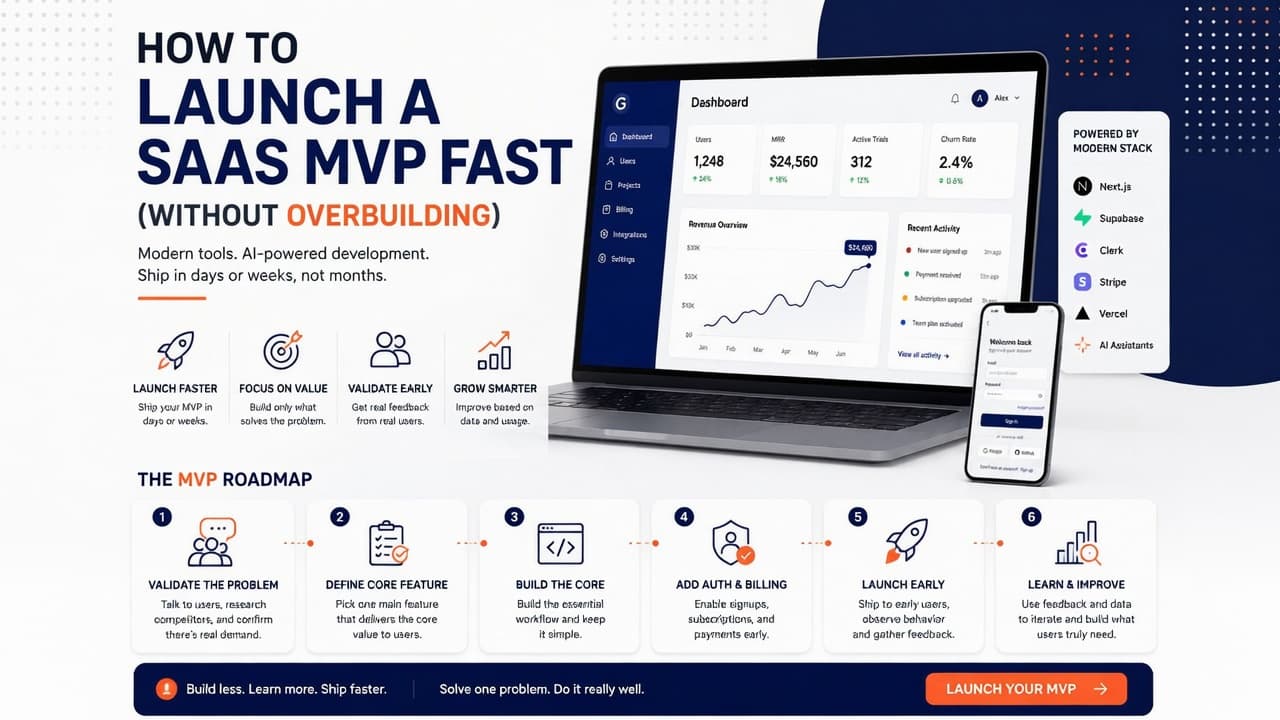
AI and modern frameworks have made it possible to ship a SaaS MVP in weeks instead of months. The problem is, nobody's told AI what not to build. Here's how to launch fast, stay focused, and avoid the trap that delays almost every first-time founder.