How to Create an MVP for a SaaS Startup (Fast, Without Overbuilding)
Most SaaS founders don't run out of money building the wrong product. They run out of money building the right product too slowly, one "while we're at it" feature at a time, before a single customer has paid.
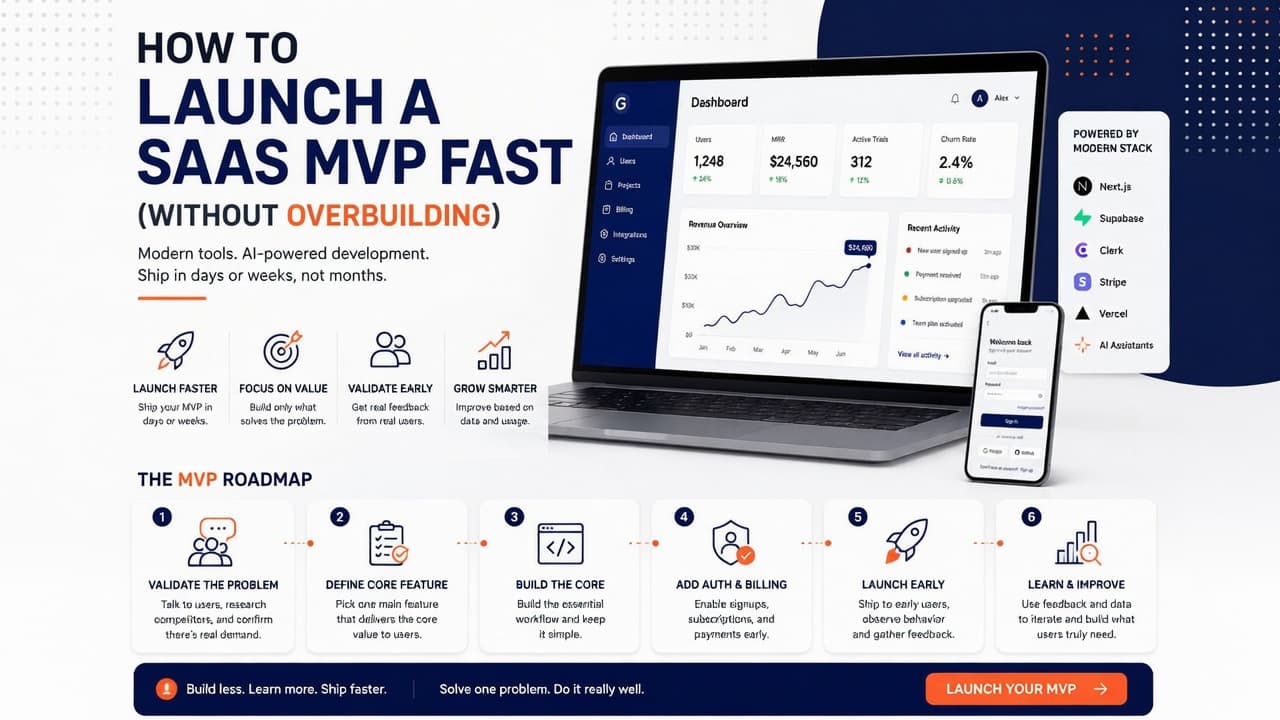
If you want to create an MVP for a SaaS startup, the short answer is this: validate the problem first, pick one core feature, build only the workflow that delivers it plus sign-in and billing, and launch in weeks rather than months. With a modern stack, a focused SaaS MVP usually takes about 5 to 8 weeks. The rest of this guide is how to keep it that small, and what to do once it's live.
What an MVP for SaaS Actually Is
An MVP, or minimum viable product, isn't a cheaper version of your full product. It's the smallest thing you can put in front of real users that answers one question honestly: does this solve a problem people have, and will they pay to have it solved?
For SaaS, that last part matters. A free prototype tells you whether people will click around. A SaaS MVP with real billing tells you whether you have a business. If the answer is yes, you build on it. If it's no, you've saved months of work on something nobody wanted.
Faster tools haven't changed that definition. They've only made it cheaper to find out.
Why SaaS MVPs Ship Faster Than They Used To
Almost nobody builds the basics from scratch any more. A typical modern SaaS stack looks like this:
Next.js for the web app
Supabase or Firebase for the database and backend
Supabase Auth, Clerk or Auth.js for sign-in
Stripe for subscriptions and billing
Vercel for hosting and deployment
AI coding assistants for the repetitive parts of the code
Instead of spending weeks on a login system, a payments flow and an admin panel, a team wires together tools that already work and spends its effort on the part that makes your product different. That shift, from building infrastructure to assembling it, is why an MVP that once took a quarter can now launch in a couple of months or less.
How to Create an MVP for Your SaaS Startup, Step by Step
Here's the order we'd follow, and the order we use with founders.
1. Validate the problem before you write any code
This step gets skipped more than any other, because writing code feels more productive than having conversations. Talk to ten people who'd use the product. Read the one-star reviews of your closest competitors; they're often more useful than the five-star ones. Look for what people already pay to solve, even badly, with spreadsheets or a tool they complain about.
If nobody is bothered by the problem, building faster only means finding that out sooner.
2. Pick one core feature and mean it
Ask yourself plainly: if a user could do only one thing in this product, what would it be? That's your core feature. Everything else is secondary until that one thing works well.
If your plan has ten "essential" features before it's usable, the problem is the scope, not the timeline.
3. Write a must-have list and a later list
Put every feature you've imagined into two columns. Must-have means a first customer can't get the core value without it. Later means it would be nice, or a bigger customer will want it one day.
Our free SaaS MVP cost calculator does exactly this: you mark each feature as a must-have or later, and it shows the cost and build time of the focused version next to building everything at once. The gap is usually several weeks, which tends to settle the argument.
4. Build only the core workflow
Most SaaS MVPs need surprisingly little:
Sign-up and sign-in
The core feature itself
A simple dashboard
Basic onboarding, so a new user reaches their first result without help
A minimal admin view, so you can see who's using it
A layout that works on a phone
No advanced settings, no enterprise features, no "while we're at it." The only job is getting a user from sign-up to their first real success as quickly as possible.
5. Don't postpone payments
"We'll add billing once we know people like it" sounds sensible, but it quietly avoids the real test. If your product is meant to make money, your MVP should test whether people will pay, not just whether they'll use it for free.
Subscriptions, plan upgrades and a billing page are a small job with Stripe. If nobody will pay for version one, twenty more features rarely change the answer.
6. Launch before it feels ready
It will never feel ready. Ship it, get your first users in, and watch what they actually do, not what they say they'll do. The first version's job is to generate feedback, not to impress anyone with polish.
What to Leave Out of Your First Version
This is where most MVPs quietly go off course. All of these can wait:
AI features that don't directly support the core feature
Team workspaces, roles and permissions
Advanced analytics dashboards
A long list of integrations with other tools
A public API
A native mobile app alongside the web app
Polished animations and dark mode
None of them tell you whether customers want the product. They just feel like progress while you build them. The mobile app is the biggest one to resist: in our planner it adds around four weeks on its own, and a web app that works well on phones is enough for most early users.
How Long Does a SaaS MVP Take, and What Does It Cost?
With us, a focused SaaS MVP (sign-in, one core feature, subscription billing and a basic admin view) starts from $4,499 and usually takes about 5 to 8 weeks. Each must-have you add moves both numbers up, which is exactly why the must-have list matters so much. For the full budget, including the running costs after launch, see MVP development cost: what to budget and what to cut.
These are general timelines and prices for typical projects, not a quote. For an exact timeline, quote and pricing, book a free consultation.
Build It Yourself, Use a No-Code Builder, or Hire a SaaS MVP Developer?
There are three realistic routes, and each suits a different founder.
Build it yourself if you're technical and the product is mostly standard parts. AI coding assistants make a solo first version more realistic than ever. The risk is that you spend your best weeks on plumbing instead of on customers.
Use a no-code SaaS MVP builder if the idea is simple and you mainly need to test demand. It's fast and cheap to start. The trade-off comes later: if the product takes off, you may hit limits on custom logic, speed or data, and need to rebuild.
Work with a SaaS MVP developer or agency if the product has real logic, integrations or billing rules, or if you want a codebase that can grow without a rewrite. You pay more upfront, so insist on a fixed scope and price, a working demo every week, and full ownership of the code.
Whichever you choose, the scope advice above doesn't change. Our SaaS development checklist for non-technical founders covers what to ask before you hire anyone.
Why Most MVPs Miss Their Launch Date
It's rarely a technical problem. It's scope creep, and it shows up in familiar phrases: "while we're in here, let's also add…", "it'll only take another day…", "we should probably support that too…"
Each of those brings more code to test and more decisions to make, and a week later the launch date has moved without anyone deciding to move it. The founders who ship on time treat the must-have list as a boundary, not a suggestion. If a feature doesn't help answer "will people use and pay for this," it goes on the later list.
AI Speeds Up the Build. It Doesn't Make the Decisions.
AI is genuinely useful for an MVP. It generates components, writes boilerplate and tests, explains a cryptic error and speeds up documentation. That's a big part of why MVPs ship faster now.
What it can't do is tell you which feature matters, who your best customer is, what they'll pay, or whether the problem is real. Those still come from talking to people and making judgment calls, and that part hasn't got any faster.
From MVP to SaaS: What Happens After Launch
Launching the MVP is the start of the real work, not the end of it. Here's what the first few months usually look like when it goes well.
Weeks 1 to 4: watch three numbers. Activation (how many sign-ups reach their first real result), retention (how many come back the next week) and conversion to paid. If activation is low, fix onboarding before anything else. If people activate but don't return, the core feature isn't solving enough of the problem.
Months 2 to 3: build what users ask for, not what you planned. Go back to your later list. Some items will turn out to matter, because customers keep asking. Others nobody mentions, and those can stay on the list indefinitely. Add integrations and team features when paying customers need them, not before.
Revisit pricing early. First prices are often set too low. Once a handful of customers rely on the product, test a higher plan for new sign-ups.
Extend, don't rebuild. If the MVP was built on a solid stack with clean code, it should grow into the full SaaS product without a rewrite. That's the main reason to get the foundations right, even when the feature list is small: multi-tenancy, billing and data structure are much harder to change later than a screen or a button.
Frequently Asked Questions
How do I create an MVP for a SaaS startup? Validate the problem with real potential customers, choose one core feature, list must-haves separately from later features, then build only sign-in, the core workflow, simple onboarding and billing. Launch, measure activation and retention, and let users shape what comes next.
How long does it take to build a SaaS MVP? A focused SaaS MVP usually takes about 5 to 8 weeks with a modern stack. Every extra must-have adds time, so the scope decides the timeline more than the tools do.
Should I add payments to my MVP or wait until I have users? Add billing from the start. If the product is meant to make money, testing whether people will pay is one of the most important things the MVP has to prove.
What's the difference between an MVP and a prototype? A prototype shows how the product might look and work, often with fake data. An MVP is a working product real customers use and pay for, so it tests demand rather than design.
Can AI build my entire SaaS MVP? AI can speed up a lot of the coding, but it can't decide what the product should do or who it's for. Those decisions still need real customer conversations and product judgment.
Do I need to rebuild my MVP to scale it into a full SaaS product? Not if it was built on a solid stack with sensible foundations for accounts, billing and data. A well-built MVP grows into the full product; a rushed one often has to be rewritten.
Keep reading
MVP Development Cost in 2026: What to Budget and What to Cut
SaaS Development Checklist for Non-Technical Founders (2026)
Custom Web App vs WordPress: Which Is Right for Your Business in 2026?
Ready to Create Your SaaS MVP?
This is the work we do every day through our SaaS MVP and product development and custom web app development services. For a real example, see the SyncReviews platform case study.
Our experienced team builds focused MVPs on a stack that can grow with you, and we'll tell you honestly which features can wait. If you'd like a structured plan first, the AI project brief generator turns your idea into one in a few minutes.
Talk to us about your MVP, and we'll help you decide exactly what it needs, and what it doesn't.