Website Speed and Revenue: What a Slow Site Really Costs You
No finance team has ever had a line item called "revenue lost to a slow website." It never shows up on a P&L, it never gets raised in a board meeting, and it never creates the urgency a dip in sales would. It just happens, spread across thousands of small moments where someone almost bought, almost booked, almost filled in the form, and didn't wait long enough to finish.
Here is the short answer on website speed and revenue. A slow site costs you money in four places: visitors who leave before the page loads, visitors who stay but convert less, ad clicks you pay for that land on a page people abandon, and search visibility you lose to faster competitors with similar content. The size of that loss depends on your own traffic, conversion rate and order value, so you can estimate it with one line of arithmetic. For a busy store the number is often large enough to pay for a speed fix in weeks. For a small site with little traffic it often isn't, and we'll show you how to tell which one you are.
How website speed and revenue are linked
Speed doesn't cost money directly. It changes how people behave. A few seconds feels like nothing on office Wi-Fi and a new laptop, but your customers are on patchy mobile data and older phones, with a competitor one swipe away.
The best-known measurement of this is a study called Milliseconds Make Millions, commissioned by Google and run by 55 and Deloitte at the end of 2019. It looked at 37 European and American brand sites and more than 30 million user sessions. When mobile speed metrics improved by just 0.1 seconds, retail sites saw conversions rise 8.4% and lead generation sites saw form submissions rise 21.6%. Those are averages across big brands, not a promise for your site.
Google's own Google Ads help pages make a similar point to advertisers: improving the speed of your landing pages is, in their words, one of the best and easiest ways to get better results from mobile ads.
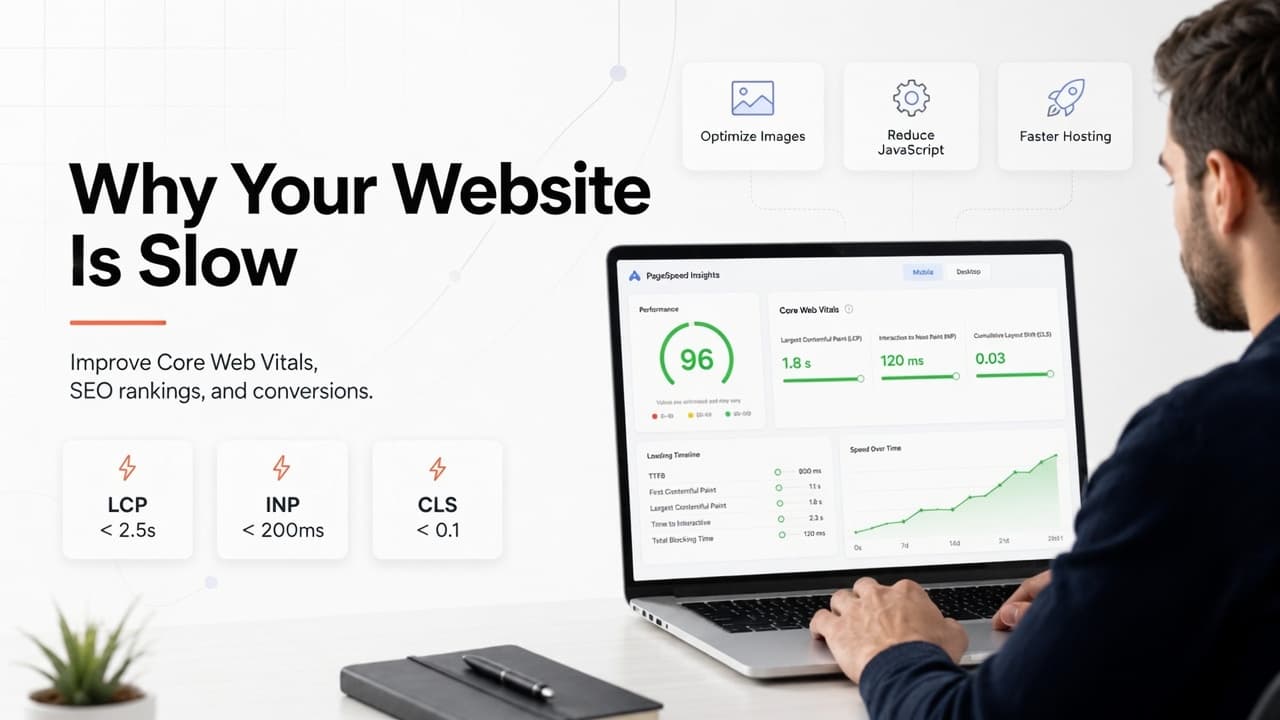
If you want the technical side (what Core Web Vitals measure, and what usually makes a site slow), we cover that in Why Is My Website Slow? Core Web Vitals, Rankings and How to Fix It. This post stays on the money.
Where the money leaks
Visitors who leave before the page appears
If someone taps your link and gives up before the page renders, many analytics tools never record them as a visit at all, because the tracking script hadn't loaded yet. So the loss is invisible twice: it isn't in your sales, and it isn't in your traffic either.
How slow website speed affects your ecommerce sales
On a store, slowness costs most on the pages closest to the money. A product page that takes five seconds to show the photo, a cart that hangs when someone changes a quantity, or a checkout button that jumps down the page just as a thumb reaches for it. None of these get logged as "left because the site was slow." They get logged as an abandoned cart, mixed in with every other reason someone didn't finish.
The Deloitte study found the same pattern deeper in the funnel: retail shoppers on faster sites were more likely to move from product page to basket, and spent 9.2% more per order. Speed affects how much people buy, not only whether they buy.
Ad spend that buys clicks people abandon
With paid traffic you pay for every click whether the page loads or not. Google Ads also counts landing page experience as one of the three components of Quality Score, alongside expected clickthrough rate and ad relevance, so a poor landing page can work against your ads as well as your visitors.
Take a hypothetical example. Say you spend $3,000 a month on ads at $2 a click, which buys 1,500 clicks. At a 3% conversion rate that is 45 leads, or $66.67 per lead. If a faster landing page lifted conversion to 3.3% (a 10% relative improvement), the same budget would bring 49.5 leads a month and the cost per lead would fall to $60.61. Nothing changed in the campaign.
Search rankings you lose to faster competitors
Google says plainly that Core Web Vitals are used by its ranking systems, and just as plainly that relevance comes first: it will still show the most relevant page even if its experience is poor. Where several pages are similarly useful, a better page experience can help you win. So speed won't rescue thin content, but it can decide close contests, and every position you drop on a commercial search is traffic you would otherwise have converted.
Trust and repeat visits
A slow, jumpy site reads as a less reliable business, especially to a first-time buyer about to type in card details, and a frustrating first visit makes a second one less likely. We leave this out of the formula below because it is hard to price, so the formula undercounts.
The formula: what is a slow website costing you?
You can estimate the cost of a slow website with four numbers you probably already have in your analytics or your sales records:
Revenue at stake per month = monthly visitors × conversion rate × value of a conversion × expected lift from a faster site
- Monthly visitors: sessions to the pages that matter, not just the home page. Product, service and landing pages are where the revenue is.
- Conversion rate: orders, bookings or enquiries divided by visitors.
- Value of a conversion: your average order value for a store. For a lead-based business, multiply your average job value by your close rate. If an average job is worth $1,200 and you win one enquiry in four, each enquiry is worth $300.
- Expected lift: the relative improvement in conversion you would expect from fixing the speed. This is the one number you have to estimate, so be conservative with it.
For the lift, we use a deliberately cautious rule of thumb: 7% more conversions for every second your main content loads slower than Google's 2.5-second target, capped at 35%. That is far smaller than the Deloitte results above, on purpose. It is the same rule our free speed tool uses.
A worked example (hypothetical)
Say an online store gets 12,000 visitors a month, converts 1.5% of them and has an average order of $80. Its main content takes 5.1 seconds to appear on mobile.
- Current monthly revenue from the site: 12,000 × 1.5% = 180 orders, × $80 = $14,400.
- Seconds over the 2.5-second target: 5.1 − 2.5 = 2.6 seconds.
- Expected lift: 2.6 × 7% = 18.2% (under the 35% cap).
- Revenue at stake: $14,400 × 18.2% = about $2,621 a month, or about $31,450 a year.
Even if you only believed a tenth of that estimate, about $262 a month, a speed fix starting at $497 would pay for itself in under two months.
You don't have to do this by hand. Our free Website Speed & Revenue Check runs your page through Google PageSpeed Insights, shows your Core Web Vitals and the biggest fixes Google suggests, then applies this formula to your own visitors, conversion rate and order value. It takes about a minute, and you can have the full report emailed to you to share with whoever signs off the budget.
If you'd rather have someone run the numbers and find the bottlenecks for you, our experienced team does exactly that as part of our website speed optimization service, starting from $497.
These are general timelines and prices for typical projects, not a quote. For an exact timeline, quote and pricing, book a free consultation.
Is website speed worth fixing? When it pays and when it doesn't
We would rather tell you not to spend money on speed than sell you a fix that won't pay back. Run the formula first, then use this table.
| Your situation | Our view |
|---|---|
| Good traffic, main content takes over 4 seconds on mobile | Fix it first. This is usually the cheapest revenue you can find. |
| You run paid ads to landing pages that load slowly | Fix it. You are paying for every click the page loses. |
| Store with a slow product page, cart or checkout | Fix those templates first, before the blog or the about page. |
| Already under the 2.5-second target, score in the 70s or 80s on mobile | Probably not worth chasing a perfect 100. Spend on your offer, copy or traffic instead. |
| A few hundred visitors a month | Speed is rarely your biggest problem. Getting more of the right visitors usually matters more. |
| Traffic is fine but nobody enquires, even on a fast site | Speed isn't the issue. Look at the offer, the next step and trust signals. |
The small-site case is worth showing in numbers. Say a local business gets 300 visitors a month, converts 2% of them, and each enquiry is worth $40. That is $240 a month from the site. If its main content loads in 3.5 seconds, one second over target, the formula gives 7% of $240, or about $17 a month at stake. A $497 fix would take around 30 months to pay back on that alone. We would advise that owner to work on traffic and conversion first, and fix speed later or as part of a rebuild.
For the "traffic but no enquiries" case, we wrote a separate guide: Website Traffic but No Leads? 7 Reasons and How to Fix Them.
Page speed and conversion rate: what a fix usually involves
Most speed problems don't need a new website. On the sites we audit, the same handful of causes come up again and again, and they can usually be fixed without changing how the site looks.
- Images: the main photo or slider is often a huge file served at desktop size to phones. Resizing, compressing, using modern formats like WebP or AVIF, and loading the top image first is usually the biggest single win.
- Third-party scripts: chat widgets, tracking pixels, review badges and testing tools all compete for the browser. We remove the ones that aren't earning their keep and delay the rest.
- Fonts: web fonts that hold back the text until they download.
- Caching and hosting: a slow server response on budget shared hosting, or a page builder that generates far more code than the page needs.
- Layout shift: images and banners without set dimensions that push the page around while it loads, which is how people end up tapping the wrong button.
Then measure before and after. Note your conversion rate for the four weeks before the change, then compare the four weeks after. Google's real-visitor speed data covers the previous 28 days, so give it a month before you judge the result. On a store, also compare average order value, since faster sites tend to lift both.
Where a site is slow because the platform itself is the bottleneck, such as an old theme stacked with plugins, a fix can only go so far. That is when a rebuild makes sense, and the costs are different. The Hidden Costs of Cheap Ecommerce Websites explains how that usually happens.
A 15-minute speed and revenue check you can do today
- Test your most valuable pages on mobile: for a store, a product page and the cart, not just the home page.
- Note how long the main content takes to appear (LCP) on each.
- Pull last month's visitors, conversion rate and order or lead value, and run the formula.
- If a tenth of the yearly figure would cover a fix within a few months, do it. If not, put the money into traffic or conversion.
Frequently Asked Questions
How does website speed affect sales? Slow pages lose visitors before they see your offer, and the ones who stay convert less and often spend less. A study commissioned by Google and run by 55 and Deloitte found a 0.1-second improvement in mobile speed metrics was associated with 8.4% more conversions on retail sites. Your own effect will differ, so measure conversion before and after any fix.
How much revenue is a slow website costing me? Multiply your monthly visitors by your conversion rate, your value per conversion and an expected lift. A cautious lift is 7% for each second your main content loads slower than 2.5 seconds, capped at 35%. Our free speed tool does this calculation with your own figures.
Does website speed affect Google Ads costs? Google Ads includes landing page experience as one of the three components of Quality Score, and Google's Ads help pages say improving landing page speed is one of the easiest ways to get better results from mobile ads. Even setting that aside, a slow page loses paid clicks, which raises your cost per lead or sale.
Is website speed worth fixing for a small business? It depends on traffic. If you have steady traffic and a slow mobile site, a fix usually pays back quickly. With only a few hundred visitors a month, the revenue at stake is often small, and getting more of the right visitors is usually the better first investment.
What page load time should I aim for? Google's target for Largest Contentful Paint, the time for the main content to appear, is 2.5 seconds or less on real visits. Below that, extra speed tends to bring smaller returns than work on your offer or traffic.
Can I speed up my website without a redesign? Usually, yes. Most gains come from images, scripts, fonts, caching and hosting, which can be fixed without changing how the site looks. A rebuild only makes sense when the platform or theme itself is the bottleneck.
Keep reading
- Why Is My Website Slow? Core Web Vitals, Rankings and How to Fix It
- Website Traffic but No Leads? 7 Reasons and How to Fix Them
- The Hidden Costs of a Cheap Ecommerce Website (That Show Up Later)
Not sure how much speed is costing you?
This is the work we do through our website speed optimization and SEO and technical optimization services. We find the pages where slowness costs the most and fix those first.
If the numbers say speed isn't your problem, we'll tell you that too, and point you at what is.
Book a free consultation and we'll run the speed and revenue numbers on your own site with you.