Headless Commerce: Is It Actually Worth It?
Headless Commerce: Is It Actually Worth It?
At some point, most growing ecommerce brands run into the same conversation. Someone on the team, a developer, an agency, or a competitor's case study, mentions "headless commerce," and it gets pitched as the obvious next step. Faster site, more design freedom, better scalability, no more fighting the limitations of a template.
All of that can be true. It's also not the full picture, and headless commerce has quietly become one of those terms that gets recommended more often than it gets properly explained. It's a genuinely significant architectural shift, not a plugin you install over a weekend, and for a meaningful share of businesses, it's not actually the right move yet.
So let's actually unpack what it is, what it costs, not just in dollars but in ongoing complexity, and where the line sits between "this would genuinely help us" and "this sounds impressive, but we don't need it."
What "Headless" Actually Means
In a traditional ecommerce setup, standard Shopify, WooCommerce, most out-of-the-box platforms - the backend (product data, inventory, checkout logic) and the frontend (what customers actually see and click through) are bundled together. The platform controls both, which is exactly why these setups are fast to launch: you're not building the plumbing, just customizing what's already there.
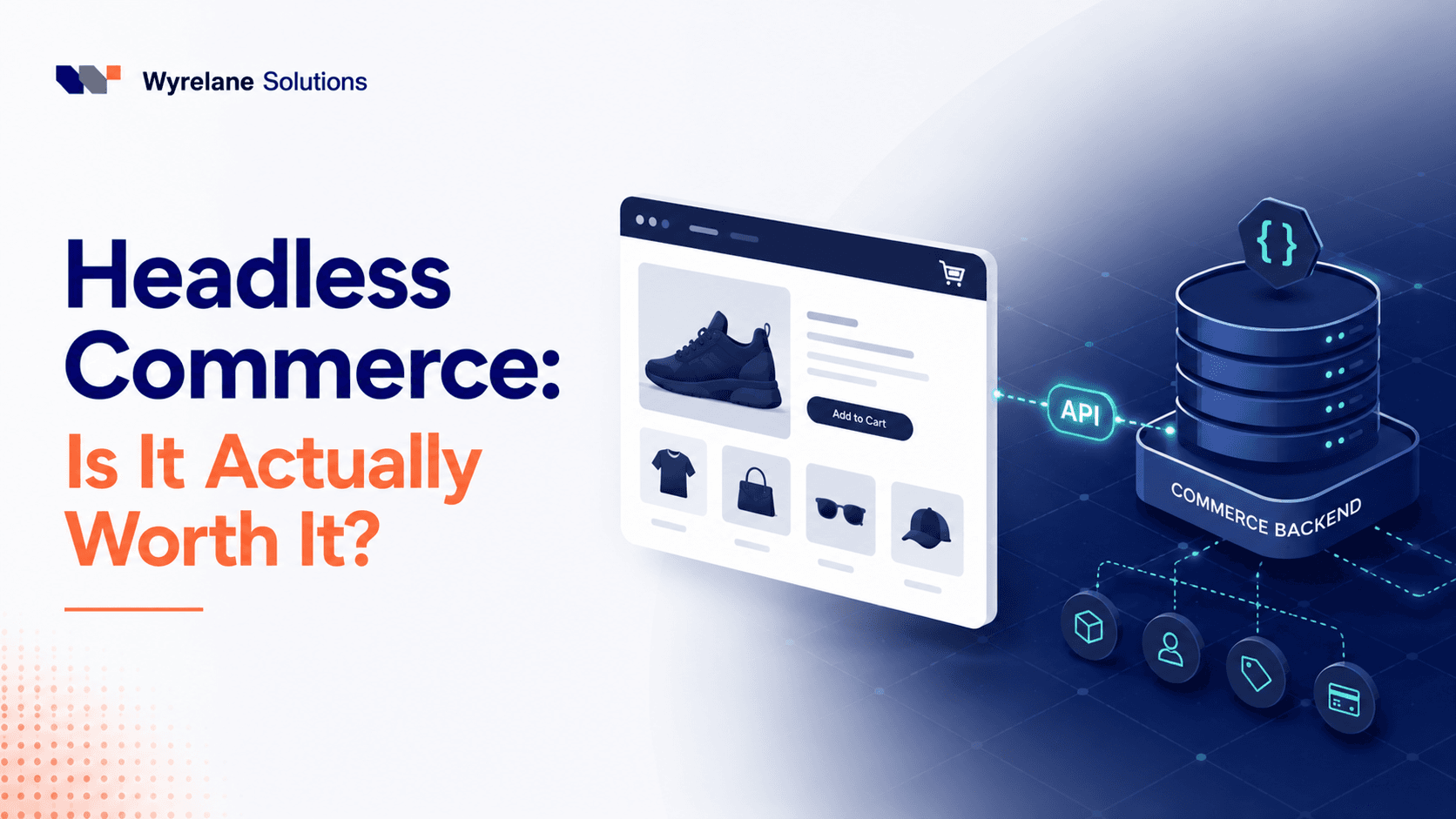
Headless commerce splits those two apart. The backend still handles products, inventory, and orders, but the frontend is built completely independently, using whatever framework makes sense for the business, and the two communicate through APIs. The "head", the customer-facing storefront, is disconnected from the commerce engine underneath it, hence the name.
The appeal is straightforward on paper: freedom. Instead of designing within the constraints of a theme, developers can build exactly the experience a brand wants, unrestricted by what the platform's templating system happens to support.
Where Shopify Hydrogen and Next.js Fit In
This is where the actual tools enter the picture, and it's worth understanding both, since they usually get mentioned in the same breath.
Shopify Hydrogen is Shopify's own framework for building headless storefronts on top of Shopify's commerce backend. It's built specifically to work with Shopify's APIs and is optimized for that ecosystem. You keep Shopify handling inventory, checkout, and order management, but build a fully custom frontend on top of it rather than using a standard Shopify theme. For businesses that want headless flexibility without abandoning Shopify's backend entirely, Hydrogen is usually the natural starting point.
Next.js, on the other hand, isn't ecommerce-specific at all; it's a general-purpose React framework that happens to be extremely well-suited to building fast, flexible storefronts, and it can be connected to essentially any commerce backend: Shopify, BigCommerce, a custom-built system, or a dedicated headless commerce platform. It offers more architectural freedom than Hydrogen, but that freedom comes with more decisions to make and more of the underlying structure to build yourself.
The practical difference: Hydrogen is the more contained, Shopify-native path. Next.js is the more open, flexible path that requires more upfront engineering decisions but gives you room to do things Hydrogen wasn't specifically designed for.
The Real Case for Headless: Performance
This is usually the first thing brought up, and it's a legitimate one. Traditional ecommerce templates load a lot of things by default: theme scripts, app integrations, tracking pixels, third-party widgets, and much of that overhead is baked into the platform whether a specific page actually needs it or not.
A properly built headless storefront strips that away. Because the frontend is built custom, only what's actually necessary gets loaded, and modern frameworks like Next.js are specifically designed around fast rendering and efficient data loading. For a large catalog site with heavy traffic, that difference in load time isn't cosmetic; it directly affects Core Web Vitals, bounce rate, and ultimately conversion rate, particularly on mobile where every extra second of load time costs more attention than it does on desktop.
The catch is that headless doesn't automatically mean fast. A poorly built headless storefront can absolutely be slower than a well-optimized traditional theme — the architecture creates the potential for better performance; it doesn't guarantee it. The gains come from the engineering quality behind the build, not from the word "headless" itself.
The Real Case for Headless: Flexibility
The second major draw is design and functionality freedom. Traditional platforms are built to serve a huge range of businesses with a shared set of templates and constraints, which means there's inevitably a ceiling on how far a brand can customize the experience before it starts fighting the platform itself.
Headless removes that ceiling. Want a genuinely unique product configurator, a highly custom checkout flow, a storefront that pulls content from multiple sources and blends commerce with editorial content seamlessly, or an experience that behaves completely differently across regions or customer segments? A headless architecture can support all of that because the frontend isn't boxed in by a template's assumptions about what an e-commerce page should look like.
This tends to matter most for brands with a strong, specific design identity, complex product catalogs, multi-brand or multi-region operations, or ambitions that go beyond what a standard theme was ever built to support.
The Part That Doesn't Make It Into the Pitch
Here's what usually gets glossed over: headless commerce is a meaningfully bigger commitment than a traditional build, in cost, in complexity, and in what it takes to maintain.
It costs more to build. You're not customizing an existing template; you're building a frontend from scratch, integrating it with a backend via APIs, and handling things a traditional platform would've given you out of the box. That's real engineering time, and it shows up in the budget.
It requires ongoing technical capability. A standard Shopify theme can largely be managed by a marketing team through the built-in editor. A headless storefront generally can't make content changes, new sections, and structural updates, which typically require a developer, which changes who needs to be involved in day-to-day site management.
It takes longer to launch. Where a traditional store can often go live in weeks, a headless build realistically takes longer, usually a few months for something done properly, sometimes more depending on how much custom functionality is involved.
It adds architectural complexity. More moving parts means more that can break, more integration points to maintain, and a genuine need for a development team that understands the specific stack being used, not just "web development" in general.
None of this makes headless a bad choice. It makes it a serious one, the kind of decision that should be made because the business genuinely needs what it offers, not because it sounds more sophisticated than a standard Shopify store.
So, Is It Actually Worth It?
Here's the honest answer: it depends entirely on where the business is, and pretending otherwise is how a lot of companies end up over-engineering a solution to a problem they didn't actually have yet.
Headless commerce tends to make sense when:
Traffic and catalog size have genuinely outgrown what a standard theme handles well
The brand has a specific, ambitious design vision that a template can't accommodate
There's a real development team or partner in place to build and maintain it
The business operates across multiple brands, regions, or highly differentiated customer experiences
Performance at scale has become a measurable, ongoing problem, not a hypothetical one
It tends to be premature when:
The business is still validating product-market fit or early growth
A standard theme's limitations haven't actually been hit yet, just anticipated
There's no dedicated development resource to maintain a custom frontend long-term
The main motivation is that a competitor did it, or it sounds more modern
A useful gut-check: if the honest answer to "what specific problem does going headless solve for us right now" is vague, that's usually a sign the business isn't at that stage yet. If the answer is specific, a named performance bottleneck, a design constraint that's actively costing conversions, a scaling limit that's already been hit, that's a much stronger signal it's time.
Frequently Asked Questions
Is Shopify Hydrogen better than Next.js for headless commerce? They're not really competing for the same use case. Hydrogen is purpose-built for Shopify's backend and is the faster, more contained path if you're staying within the Shopify ecosystem. Next.js offers more architectural flexibility and can connect to virtually any backend, but requires more upfront decisions and engineering.
How much more expensive is headless commerce than a traditional Shopify store? It varies significantly based on scope, but headless builds typically cost multiple times more than a standard themed store, largely because the frontend is being custom-built rather than customized from an existing template. Ongoing maintenance costs are usually higher too, since changes typically require developer involvement.
Does headless commerce automatically improve site speed? No. It creates the potential for better performance because there's less default overhead, but a poorly engineered headless site can be just as slow, or slower, than a well-optimized traditional theme. The performance gains come from the build quality, not the architecture alone.
What size business should consider headless commerce? Generally, businesses with established traffic, complex catalogs, multi-region or multi-brand operations, or specific performance and design needs that a standard platform can't meet. Early-stage or smaller businesses usually get more value from a well-optimized traditional platform first.
Final Thoughts
Headless commerce isn't a trend to chase or a badge of technical sophistication; it's an architectural decision that trades simplicity for flexibility and control, and that trade only pays off when a business has actually reached the point of needing what it offers. Shopify Hydrogen and Next.js both make headless more achievable than it used to be, but neither one changes the fundamental calculation: more freedom, more performance ceiling, and meaningfully more complexity to manage.
For the right business, at the right stage, it's genuinely worth it. For a business still growing into its current platform's limitations, it's usually a more expensive way to solve a problem that hasn't actually shown up yet.
Considering Headless Commerce for Your Business?
Whether you're evaluating Shopify Hydrogen, exploring a Next.js storefront, or trying to figure out if your business has actually hit the point where headless makes sense, our custom development team can help you make that call honestly and build it properly if it does.
Talk to us about your ecommerce architecture before committing to a headless build, and we'll help you figure out if it's the right move for where you actually are.